




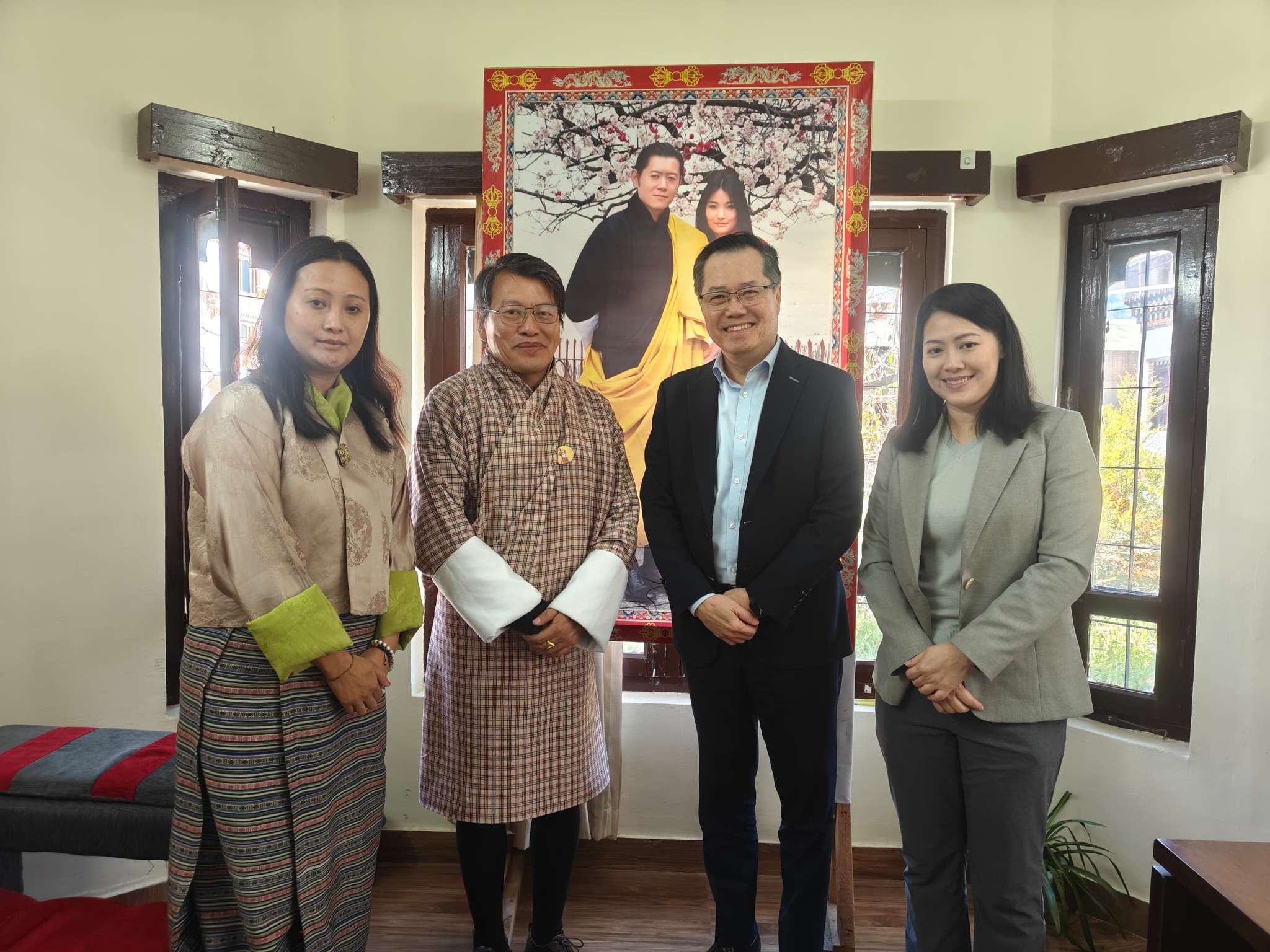
Thimphu, 25 November 2026. Ecopha DrukBees was honoured to welcome the Asia Pacific Sustainable Aviation Centre (APSAC) to Thimphu today. The APSAC delegation was led by its Chief Executive Officer, Mr. Philip Goh, and joined by Deputy Director Ms. Ke Liyin. The morning meeting focused on one big question: how can Bhutan help the Asia-Pacific region fly more sustainably?

Who is APSAC?
APSAC was set up by the Civil Aviation Authority of Singapore (CAAS) and launched in July 2025. It is a not-for-profit centre that helps Asia-Pacific States advance sustainable aviation through policy research, collaboration and capacity building. Its work supports the International Civil Aviation Organization (ICAO) Long-Term Aspirational Goal (LTAG) of net-zero carbon emissions for international aviation by 2050. An Advisory Council of leaders from aviation, energy and green finance, including Airbus, Boeing, IATA, Chevron, ExxonMobil, Neste and GenZero, guides its work.
Mr. Philip Goh is APSAC’s founding CEO. He brings close to four decades of airline industry experience, including many years at Singapore Airlines and a role as IATA’s Regional Vice President for Asia Pacific. Bhutan already has links with APSAC: Bhutanese participants have taken part in APSAC’s Roundtable and its Growing Aviation Sustainably training.
Our presentation: Pongamia, SAF and a circular bioeconomy
Karma Dorji, Promoter of Ecopha DrukBees, presented the company’s Sustainable Aviation Fuel and Pongamia Bioeconomy Project. Ecopha DrukBees is an Australia–Bhutan venture with Ecopha, officially opened in Bhutan in July 2026. It is building a research, demonstration and certification hub rather than a mass-production plant.

Pongamia as a non-food feedstock
Pongamia is a hardy, oil-bearing tree that can grow on marginal land. Its seeds are non-edible, so it does not compete with food crops. The presentation explained that Pongamia oil fits the HEFA (Hydroprocessed Esters and Fatty Acids) pathway. HEFA is the most mature commercial SAF route today and Ecopha’s primary route. It produces a fuel that is highly compatible with conventional jet fuel.
A circular biorefinery: SAF + PHA bioplastics
At the heart of the project is Ecopha’s patent-filed integrated biorefinery. The process is designed to turn Pongamia oil into two products: sustainable aviation fuel and PHA, a biodegradable bioplastic. By design, the output is roughly 85–90% SAF and 10–15% PHA. The PHA is described as home-compostable and marine-safe, and it does not leave microplastics behind. Residue goes back to the plantation, which closes the loop and supports land restoration and carbon credits. The idea is simple: one non-food crop, two high-value products, one circular bioeconomy.
The Tree Passport: traceability from tree to tank
The team also presented the Global Tree Passport System, a digital identity for every tree. Each plant gets:
- a unique ID and GPS location
- a genetics and provenance record
- AI-assisted growth monitoring with sensors on the tree
- carbon sequestration and biomass data
- yield tracking for a full chain of custody
- a QR code linking the plantation to the final SAF or PHA product
Traceability of this kind is the foundation for credible certification.
Progress on the ground in Nganglam
First planting has begun in Nganglam with 1 kg (about 400) imported Pongamia seeds. Work is ongoing on a solar-powered nursery design, the Tree Passport rollout and farmer engagement. Ecopha DrukBees also works with local partners, including Bhutan Agro Industries, Drukair and the Ministry of Agriculture and Livestock.

Bhutan as a demonstration and certification hub
A key theme of the morning was how Bhutan can serve the wider region. Bhutan is carbon-negative and guided by Gross National Happiness. It is well placed to demonstrate, validate and certify a traceable, circular SAF model that larger regions could later adopt.
Areas for possible cooperation
After APSAC presented its work and regional priorities, the two teams had an open discussion. Both sides were positive about exploring cooperation in four areas:
- Capacity building: training on non-food SAF feedstocks, HEFA pathways, sustainability criteria and ICAO requirements.
- A national sustainable aviation roadmap: technical support for Bhutan’s aviation emissions assessment and a national SAF strategy, including Gelephu.
- SAF development: joint studies on Pongamia lifecycle analysis, regional supply options and deployment.
- Green financing: exploring blended finance, carbon credit frameworks and investment instruments.
Ecopha DrukBees proposed several next steps for APSAC’s consideration. These include a follow-up technical discussion on HEFA integration, lifecycle analysis and certification pathways, a cooperation framework, and sharing what Bhutan learns from the demonstration and the Tree Passport across the region. These are proposals for further discussion.
Bhutanese hospitality
As always in Bhutan, the meeting began with a warm welcome. Guests were served tea with zow (roasted rice), and a short break brought shamday, a traditional Bhutanese rice dish with vegetables, chilli, butter and egg. It was a small taste of Bhutan for our visitors from Singapore.

Thank you, APSAC
From Ecopha DrukBees, the meeting was attended by Karma Dorji (Presenter/Promoter), Mrs. Tshering Dema, Mr. Phub (CEO) and our support staff. We sincerely thank Mr. Philip Goh and the APSAC team for travelling to Bhutan and for an open, constructive conversation. We look forward to continuing the dialogue on how Bhutan can contribute to cleaner skies across the Asia-Pacific.

Learn more about Ecopha at ecopha.bio and about APSAC at ap-sac.org.